

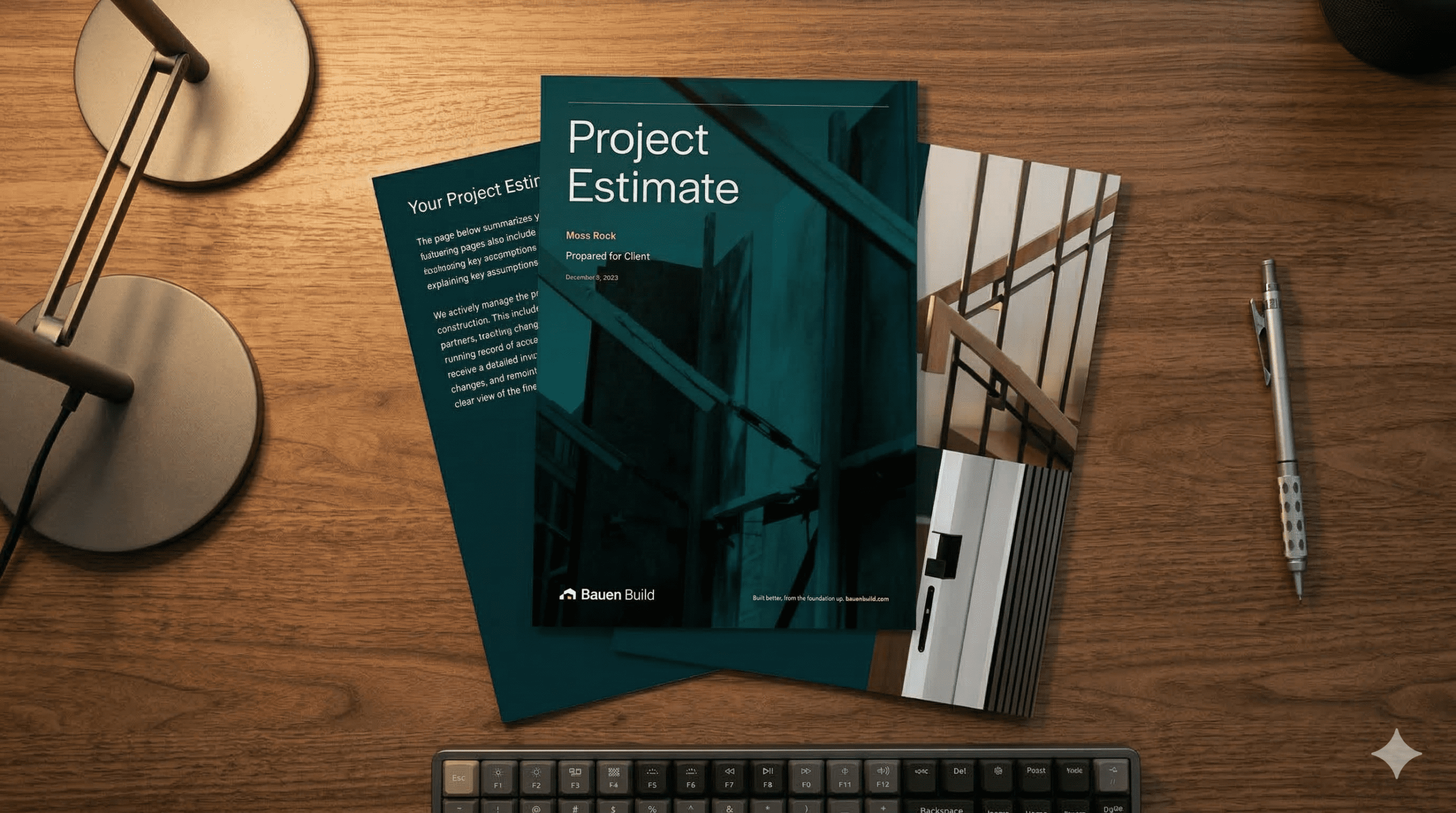
When people ask, “What will this house cost?” at the beginning of a project, they’re usually hoping for a single, definitive number or a narrow range.
In reality, thoughtful pricing is a process, not a moment.
At Bauen Build, we treat pricing as something that evolves alongside design. The more information we have, the more precise the number becomes. Our goal isn’t to guess early and hope for the best. It’s to build budget certainty over time so that once preconstruction is complete and you are ready to sign a construction contract, you know what to expect.
Preventing Budget Shock
In many traditional processes, pricing lags behind design. A client and architect may spend months developing a beautiful home — dramatic rooflines, complex overhangs, intricate structural elements — only to discover late in the process that the project exceeds the intended budget.
By then, everyone is emotionally invested. Redesign can be frustrating, time-consuming, and expensive. Our approach is designed to prevent that outcome. By refining pricing two to three times during the design phase, we align ambition with financial reality in real time.
The Funnel Approach to Pricing
Michael Wilks, our Operations Director, describes our process as a funnel.
“At the beginning, we’re working with broad assumptions. As design progresses, the information tightens and the cost estimates tighten with it.”
- Conceptual Phase
At the top of the funnel, we are working with limited information. We understand general square footage, site conditions, and performance goals, but many details are still being defined. At this stage, it would be unrealistic to provide a fixed number. Instead, we provide a well-informed range based on historical data, project complexity, and site considerations. The goal is to determine early whether the project aligns with your budget before investing heavily in the full design. - Schematic Design
As the project moves into schematic design, the funnel begins to narrow. Wall assemblies are selected. Structural systems are clarified. Windows and major systems are defined. We begin gathering real input from trade partners. At this point, we may reach approximately 60–70% budget certainty. - Design Development & Permitting
During design development and permitting, the details sharpen further. Exterior finishes are refined. Structural drawings are coordinated. Major systems are locked in. The goal at this stage is to reach roughly 90% certainty before final selections are made. - Final Selections
Once the “touch and feel” items — cabinetry, tile, flooring, fixtures — are finalized, we arrive at a fully informed, contract-ready budget. By then, the number should feel expected, not surprising.
This structured approach also provides architects and consultants with clear checkpoints. Design decisions are evaluated early, preserving design intent while respecting the budget.

Value Engineering: Solving without sacrificing
A central part of this process is value engineering. This means offering alternative solutions that maintain architectural and structural intent while improving efficiency and cost performance.
And the earlier it happens, the more impact it has.
For example, on one project we transitioned from slab-on-grade to a crawl space to accommodate mechanical systems. The original design called for I-joists with drywall protection in a tight crawl space — a labor-intensive and costly approach.
During design, we evaluated switching to LVL floor framing. The result was faster installation, lower labor cost, and a more robust framing system that met fire code requirements. The design intent remained intact and the cost actually lowered.
In another project, we optimized a roof overframing strategy by adjusting framing members to reduce labor complexity. Even though the material costs were more, simplifying the system to LVLs reduced labor hours and produced meaningful savings – while increasing structural performance.
These are the kinds of decisions that are relatively simple to make at the top of the funnel and increasingly expensive once construction begins.
Pricing Transparency Along the Way
For homeowners, the most important outcome of this process is an understanding of what their project will look like and clear understanding of the various cost drivers.
We want you to understand where the budget stands at each checkpoint. We want you to see tradeoffs clearly. And we want you to feel confident that the design is aligned with the investment you’ve planned.
As Michael puts it, the goal is “price clarity along the way during design.”
“There should be no surprises when it’s time to sign the construction contract.”
This discipline benefits everyone involved. For homeowners, it creates confidence and clarity. For architects and consultants, it reinforces a collaborative, data-informed process. And once construction begins, that alignment translates into smoother execution and a more predictable build.
Clarity Builds Confidence
Custom high-performance homes are complex systems. There are countless design possibilities — and just as many ways for costs to drift if they are not actively managed.
Our pricing evolution model brings structure to that complexity. We want you to walk onto your job site feeling reassurance, knowing that the design you love is perfectly aligned with the budget you’ve set.

